Affichage des articles dont le libellé est Rex Ingram. Afficher tous les articles

dimanche 30 janvier 2011

La suite des aventures de Michael Powell

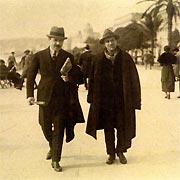
Henri Matisse et Rex Ingram devant la villa Serena.

J'apprenais rapidement, grâce à la patience et à la gentillesse de mes professeurs. Même Harry, apparemment le plus impatient des hommes, était communicatif avec moi au sujet de l'art. Il m'emmenait avec lui quand il rendait visite à Matisse dans son appartement de la promenade, situé au tournant qui contourne la citadelle de Nice, Rauba Capeu en niçois. J'avais rencontré un certain nombre de peintres sur la Côte, en particulier Bonnard, qui était doux et peu loquace. Il nous déclara : "Un peintre en bâtiment m'a dit l'autre jour : Monsieur Bonnard, vous êtes peintre. La première couche de peinture, ça va tout seul, hein ? Mais la seconde ?"
Matisse était autre chose. Il avait l'allure et le langage d'un professeur, et il était méthodique. Il avait une fiche pour chacun de ses tableaux, et nous avions entrepris de photographier toutes les toiles qu'il avait pu réunir, à Nice ou à Paris, et de réduire les photos à la dimension de timbres-poste pour les fixer sur les fiches. (...)
J'allai voir Matisse peu avant sa mort dans son grand appartement ensoleillé du palais de Cimiez au-dessus et au-delà de Nice. C'était un vieil hôtel particulier transformé en appartements. (...) J'étais venu lui demander si cela l'intéresserait de faire un nouveau décor pour le ballet Shéhérazade, musique de Rimsky-Korsakov, pour une série de films d'art que je préparais. Le projet l'enthousiasma : "Nous allons essayer cela ! Nous allons faire un coup*." Mais ces films ne se firent jamais.
(Rose c)
L'ouverture du Mépris (1963) aux studios de la Victorine.

Pendant tout cet été 1925 nous avons préparé les effets spéciaux et les scènes maritimes de Mare Nostrum. Je crois que toutes les scènes dramatiques et intimes de l'histoire avaient été tournées pendant le solstice d'été. Je ne m'étais pas attendu à la grande chaleur sèche de Nice en été. A l'époque on ne cherchait pas le soleil, avec les conséquences néfastes pour l'épiderme que cela entraîne. La chaleur venait graduellement, mais quand elle venait elle était oppressante. Le métal était brûlant. Il fallait entourer la caméra de glace pour empêcher l'émulsion de la pellicule de fondre. L'heure du déjeuner était prolongée de deux ou trois heures pour permettre à tout le monde de faire la sieste ou d'aller se baigner. Les loges étaient des fournaises, je ne pouvais plus y dormir ; il n'y avait pas de climatisation. On acceptait le fait que dans les villas, sinon à Nice, les sols de marbre étaient froids en hiver, les chambres trop chaudes en été. Je pointais désormais comme les autres employés du studio. Très audacieusement, je pris une chambre à Nice, dans une maison assez douteuse de la rue Paradis, centrale mais bon marché. (pp. 186-187)
* En français dans le texte.

Précédents extraits :

vendredi 28 janvier 2011

Michael Powell, deuxième.


Tournages à la Victorine : Le Magicien (1926), Alice Terry et Rex Ingram et Le Jardin d'Allah (1927).

La Victorine avait de toute évidence été la villa d'une riche. Le terrain couvrait environ cinq hectares. La plus grande partie était retournée à l'état sauvage, mais le jardin potager existait toujours. Il y avait des oliviers et des loquats, des yuccas et des agaves, et un très haut palmier au centre du terrain. En fait, cela ressemblait exactement au backlot d'un studio hollywoodien, et ce n'est qu'aujourd'hui, en y repensant, que je me rends compte à quel point les déracinés d'Hollywood devaient s'y sentir chez eux. Car ils n'étaient d'Hollywood, ils n'y étaient pas nés : ils avaient émigré de New York ou de Chicago, attirés par la gloire des Griffith, Mack Sennett, Thomas H. Ince et Charles Chaplin. C'avait été une nouvelle ruée vers l'or, et des fortunes s'étaient faites parmi les orangeraies d'Hollywood Boulevard et Vine Street. Pour ceux qui avaient suivi Rex Ingram jusqu'ici pour tourner Mare Nostrum, Nice n'était pas tellement différente.
En 1925 la Victorine était un studio de cinéma depuis quelques années, pour la même raison qui avait attiré D. W. Griffith et les autres vers l'ouest : le soleil. Il y avait trois petits studios vitrés d'environ seize mètres sur douze, et un grand studio, de superficie double, dont la verrière avait été noircie afin de permettre l'usage de la lumière artificielle à l'intérieur. Tous les studios étaient équipés de grandes portes coulissantes et de jalousies permettant de contrôler l'intensité de la lumière venant de l'extérieur. Des rangées de loges ressemblant à des cabines étaient attenantes aux studios.
Une seconde villa, autrefois celle d'un intendant ou d'un jardinier, servait de bureaux à la troupe, car je vis des gens entrer et sortir et entendis le bruit de machines à écrire et des sonneries de téléphone. Au sommet de la côte en pente douce, derrière la villa blanche, se trouvait un long bâtiment ressemblant à une grange qui faisait bien soixante mètres et abritait évidemment les ateliers des menuisiers et des sculpteurs. L'essentiel de l'activité semblait concentré là. Par les portes ouvertes je voyais des lumières et des générateurs, une foule de gens en mouvement, et j'entendais des voix américaines.
Harry réapparut au moment où une procession de femmes pénétrait dans la villa, portant costumes, accessoires, maquillage, perruques blondes et tout ce qui caractérise une vedette de cinéma. De toute évidence Alice Terry travaillait aujourd'hui. Mon coeur battait plus fort, car si elle était là, son metteur en scène de mari ne pouvait pas être loin. Harry prenait des notes, à son habitude. "Venez Powell !" Il me précéda sur la route en direction de l'équipe au travail. (pp. 160-161)

vendredi 14 janvier 2011

Michael Powell, 1ère chance avec Rex Ingram.

Mais toutes ces sages préoccupations littéraires allaient s'évanouir quand je revis mon père, à la gare de Beaulieu. Il était aussi excité que moi.
- Voilà ta chance, Mick. Une compagnie américaine qui tourne un grand film ici, à Nice. Hier ils ont filmé toute la journée à Villefranche, avec un sous-marin français de Toulon. Des gens de l'équipe sont venus à Saint-Jean, ils ont regardé la terrasse et j'en ai invité quelques-uns à dîner chez Maxim à neuf heures. Je leur ai dit que tu savais tout sur le cinéma, et ça les a fait rire. Ils ont l'air sympathiques.
J'avais du mal à assimiler.
- Une compagnie américaine ? Quelle compagnie ?
- Metro, je crois qu'ils l'appellent.
- Metro ! J'en avais le souffle coupé.
- Ils tournent dans toute la Méditerranée depuis quelques mois - Naples, Pompéi, Barcelone, Marseille, et maintenant ils sont ici pour finir le film aux studios de la Victorine à Nice.
- La Victorine ?
- C'est dans le quartier de la Californie. Sur la colline, au-dessus du chemin de fer. Tu n'y es jamais allé.
- Le film s'appelle comment ?
- Mare Nostrum.
J'avais la gorge sèche.
- C'est Rex Ingram, dis-je dans un souffle.
- Qui ?
- Rex Ingram. Il a fait Les Quatre Cavaliers de l'Apocalypse. Il a fait Le Roman d'un roi. Il a fait Scaramouche.
- Vraiment ? Ca alors !
Rex Ingram en compagnie de son actrice et épouse Alice Terry devant un kiosque niçois et l'affiche de Mare Nostrum (1926).

- Est-ce qu'il vient ce soir ?
- Aucune idée. Je les ai tous invités. Ca ne sert à rien de faire les choses à moitié. On va aller à Nice ce soir, toi et moi, et on passera au bar de l'hôtel Ruhl. C'est là qu'ils sont descendus, et il y en a toujours quelques-uns au bar. Après, on verra.
La petite voiture fonça comme un boulet à travers le port, grimpa la côte à grand bruit et fit son entrée à l'hôtel sur les chapeaux de roues. L'arrivée de mon père sur la terrasse était toujours spectaculaire.

Carabiniers et policiers près de l'hôtel Ruhl en 1943.

- Le capitaine Powell est arrivé ! Avec son fils*.
J'étais un point d'interrogation. Serais-je ou non l'héritier présomptif de l'hôtel ?
André Caramello, fils du héros de l'épisode Mange-Cafard*, était un ami. Nous avions - et avons toujours, j'espère - le même âge. Nous étions tous deux passionnés de fleuret. Nous jouions aux mousquetaires sur le port. Il essayait toujours de deviner mes intentions. La Voile d'or, avec ses vingt-quatre chambres, était appréciable ; mais c'était surtout son immense terrasse que tout le monde convoitait. Avec parking ! Et le succès ou l'échec d'un hôtel commençait déjà à dépendre du parking.
Au bar du Ruhl mon père fut accueilli par le barman comme un vieil ami. Henri connaissait les secrets de tout le monde et servait de confesseur et de banquier à tous les paumés, maquereaux et putains de la côte.
Les célébrités de passage descendaient au Negresco ou au Ruhl. S'il étaient russes, ou nouveaux venus, au Negresco, hôtel à l'architecture pâtissière tape-à-l'oeil, sur la promenade des Anglais. S'ils étaients déjà venus à Nice ils allaient au Ruhl, situé en face du casino de la jetée, pas loin du casino municipal, et à trente secondes de l'établissement bien tenu de Mme Régina dans la rue de France. Mon père se commanda un Manhattan, et pour moi un gin-fizz. "Et pas trop de gin, Henri ; c'est mon fils, vous savez*." (pp. 156-157/ Livre Premier : le muet, pp. 27-222).
* En français dans le texte.

Extrait de l'autobiographie de Michael Powell - première photo en haut -, Une vie dans le cinéma, traduite de l'anglais par Jean-Pierre Coursodon. Publié chez Actes Sud / Institut Lumière, en 1997 ; épuisé.

mercredi 7 juillet 2010

Sur les studios de cinéma : The New York Times.

"At a French Studio,
Great Ghosts
and Big Plans",
The New York Times,
13 mai 2007.

NICE, France
FOR more than 30 years the olive- and palm-tree-laden grounds of the Victorine studios here, just steps from the sea, have tempted a steady stream of producers and businessmen hoping to revive the place where classics like Truffaut’s "Day for Night" [La Nuit américaine, 1973] and Hitchcock’s "To Catch a Thief" [La Main au collet, 1955] were filmed.
But a very Mediterranean mix of local bureaucracy and political corruption has helped defeat them all, including Michael Douglas and his brother Joel, who took charge of the Victorine in the mid-1980s, only to leave a few years later with little to show for it.
“We’ve been disappointed so many times,” said Emile Martin, 64, who began as the Victorine’s film projectionist in 1965 in the studio’s heyday and is the archivist and unofficial historian. “We had a lot of hope when the Douglas brothers came, but Michael hardly ever showed up, and Joel just played pinball all day.”
Yet the entrepreneurs keep coming, and the Victorine, whose Paramount Pictures-style white arched gate was recently refurbished, has flickered back to life, most recently to capture the antics of Rowan Atkinson on film. Mr. Atkinson, the British comic best known to American audiences for his hammy cameos in movies like "Four Weddings and a Funeral" [Quatre mariages et un enterrement, 1994] and "Love Actually" [Idem, 2003], is no Cary Grant. Nor is his new movie, "Mr. Bean's Holiday" [Les Vacances de Mr. Bean, 2007], reminiscent of Hitchcock, though it is set in the south of France. But for Jean-Pierre Barry, the owner of Euro Media Television, the Paris-based television and film powerhouse, which took over the studio in 1999, the Bean movie demonstrates that his plan to renew the studio by vigorously promoting it as a film- and TV-friendly place is working.
“Mr. Bean’s Holiday,” which recreated part of the Cannes Film Festival on the Victorine’s soundstages, has been a huge hit internationally and arrives in the United States in August. The Victorine “must survive, and we’re going to see to it that it does,” Mr. Barry, who began Euro Media on a shoestring in 1983, said as he sped down a Nice highway in his Mini-Cooper, bound for the airport to pilot his own jet back to Paris.
“I am Belgian, don’t forget,” he said. “We are different from French. We have a fighting business mentality. We are making sure Hollywood knows we’re here and open for business.”
But even Mr. Barry concedes he faces an uphill battle and a deadline. The Victorine must compete with other established studios in Europe, while newer facilities dangle cheaper labor and tax breaks to lure productions. And he and Euro Media face a homegrown political obstacle: the city, which owns the property, can turn the studio into a housing development in 2018.
The Victorine’s history is a tangled one, but one that is a quintessentially south-of-France story, replete with jet-set-era glamour, tragedy and shady subplots. Created in 1919, about the time the first studios in Hollywood were built, the Victorine has played host to the likes of Jeanne Moreau, Brigitte Bardot, Grace Kelly, Lauren Bacall and David Niven. David Lean died during preproduction at the Victorine of his last, never-completed movie, “Nostromo.” The studio has survived one world war and weathered three major fires. Yet those blows didn’t compare with what Mr. Martin calls the studio’s “catastrophic years,” 1975 to 1983, during the long reign of Nice’s most notorious mayor, Jacques Médecin.
Mr. Médecin presided over such blatant corruption on the Côte d’Azur that Graham Greene, then a resident of nearby Antibes, helped force a criminal investigation that ultimately resulted in Mr. Médecin’s arrest and imprisonment. But not before Mr. Médecin, a regular at the studio commissary, was able to install cronies as studio bosses, some of whom pocketed profits they made from visiting production companies and left without ever reinvesting any money in the studio.
Some, Mr. Martin said, sabotaged the place on their way out, cutting cables and breaking equipment. “It was what we call a southern way of doing things,” said Antoine Sabarros, a film and television producer who has worked at the Victorine for 30 years. “But it got to the point where you had to fight to get anything accomplished here, and I’ve gotten sick of fighting.”
Conditions at the studio were so bad during the filming in 1982 of Sean Connery’s final appearance as James Bond, in "Never Say Never Again" [Jamais plus jamais, 1983], that the director, Irvin Kershner, threatened to stop production if the filthy screens in the projection room, yellowed from decades of smoking, were not cleaned.
“The grass was so high it was like a savanna out here,” Mr. Martin remembered. “The crew for the Bond film had trouble moving the equipment around. It was embarrassing.”
The stirrings of a comeback began in 1996, when the action star Jean-Claude Van Damme arrived to film "Maximum Risk" [Risque maximum, 1996] and "Double Team" [Id., 1997]. And Euro Media’s takeover — with its strategy of pursuing a mix of prestige and lowbrow films, along with television shows and commercial production for brands like Toyota and McDonald’s — has accelerated the rejuvenation of the Victorine, officially called Studios Riviera. John Frankenheimer’s "Ronin" [Id., 1998], with Robert De Niro; "Swordfish" [Opération Espadon, 2001], starring John Travolta; and the director Neil Jordans "Good Thief" [L'Homme de la Riviera, 2002] have been filmed at the studio. And the lowbrow French surfer film "Brice de Nice" [Id., 2005] one of the biggest box office successes in French history, was shot partly at the Victorine in 2004, along with other French films starring national legends like Catherine Deneuve and Miou-Miou.
Since Euro Media took over in 1999, 24 feature films have made use of the Victorine, and the number of television shows shot there has doubled. In 2000, 18 television commercials were made there; by 2005 the number had risen to more than 50.
Though the Victorine is faring better, the competition among European studios to lure filmmakers has never been more fierce. The studio has always been dwarfed by Rome’s larger Cinecitta Studios ("La Dolce Vita" [Id., 1960] and "The Gangs of New York" [Gangs of New York, 2002] to name a few), and today studios in Eastern Europe can offer cheaper shoots. Even Pinewood Studios near London recently lost its stranglehold on the James Bond franchise when the producers of "Casino Royale" [Id., 2006] decided to film at the Barrandov Studios in Prague.
And there’s a more ominous threat in Spain, where in 2005 an $88 million studio, Ciudad de la Luz, opened in the coastal city of Alicante. French filmmakers are signing on; the new Gérard Depardieu movie, "Astérix aux Jeux Olympiques" [Id., 2008] was shot there last year. Unlike the Victorine, which receives no government money, the Spanish government hands out hefty subsidies, including a reported six million euros — more than $8 million — for "Astérix."
To compete better, Euro Media and Mr. Barry have upgraded the Victorine and the marketing efforts for it. The company recently opened a modern recording complex, run by a French-born Los Angeles music producer. And last year the Victorine hired its first international marketing agent, Dana Davidson Thevenau, an American who was the director of a French film commission. She recently went to Los Angeles to raise the studio’s profile in the film industry and is overseeing an elaborate marketing display at the Cannes Film Festival, which begins Wednesday.
“It’s a huge job to turn this studio around,” Ms. Thevenau said, “especially when filmmakers can go anywhere in the world. But we have this incredible location, and we have this amazing history. When Rowan Atkinson was here, he wanted to hear all the stories about Truffaut and Hitchcock and Grace Kelly.”
Standing on the upper patio of the Victorine’s villa, built for a prince in the late 1800s and the headquarters for a succession of studio bosses, Mr. Martin reminisced about those glory days. He recalled sharing some of Katharine Hepburn’s chocolates during "The Madwoman of Chaillot" [La Folle de Chaillot, 1969] drinking whiskey with Richard Burton on "The Comedians" [Les Comédiens, 1967], playing himself in a bit part in "Day for Night" and watching workers construct a swimming pool that Elizabeth Taylor requested but never used.
If that history isn’t enough, some veterans of the Victorine trust in another savior: the ghost of Rex Ingram, an Irish-born Hollywood director who took over the Victorine in 1925 and shot several films there. “I heard about the ghost the first day I started here,” said Patricia Douglas, a French film production coordinator and the former wife of Joel Douglas, who met him when the Douglas brothers filmed "The Jewel of the Nile" [Le Diamant du Nil, 1985] at the Victorine in 1985. “Everyone said it was a positive ghost.
“And,” she added, “it doesn’t want the Victorine to die.”
Dana Kennedy